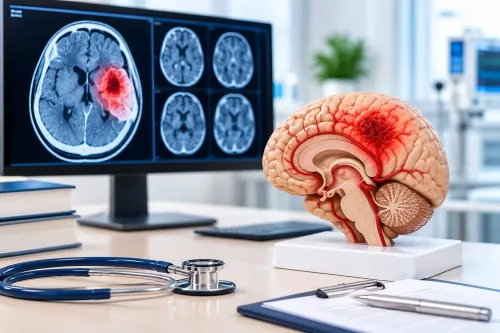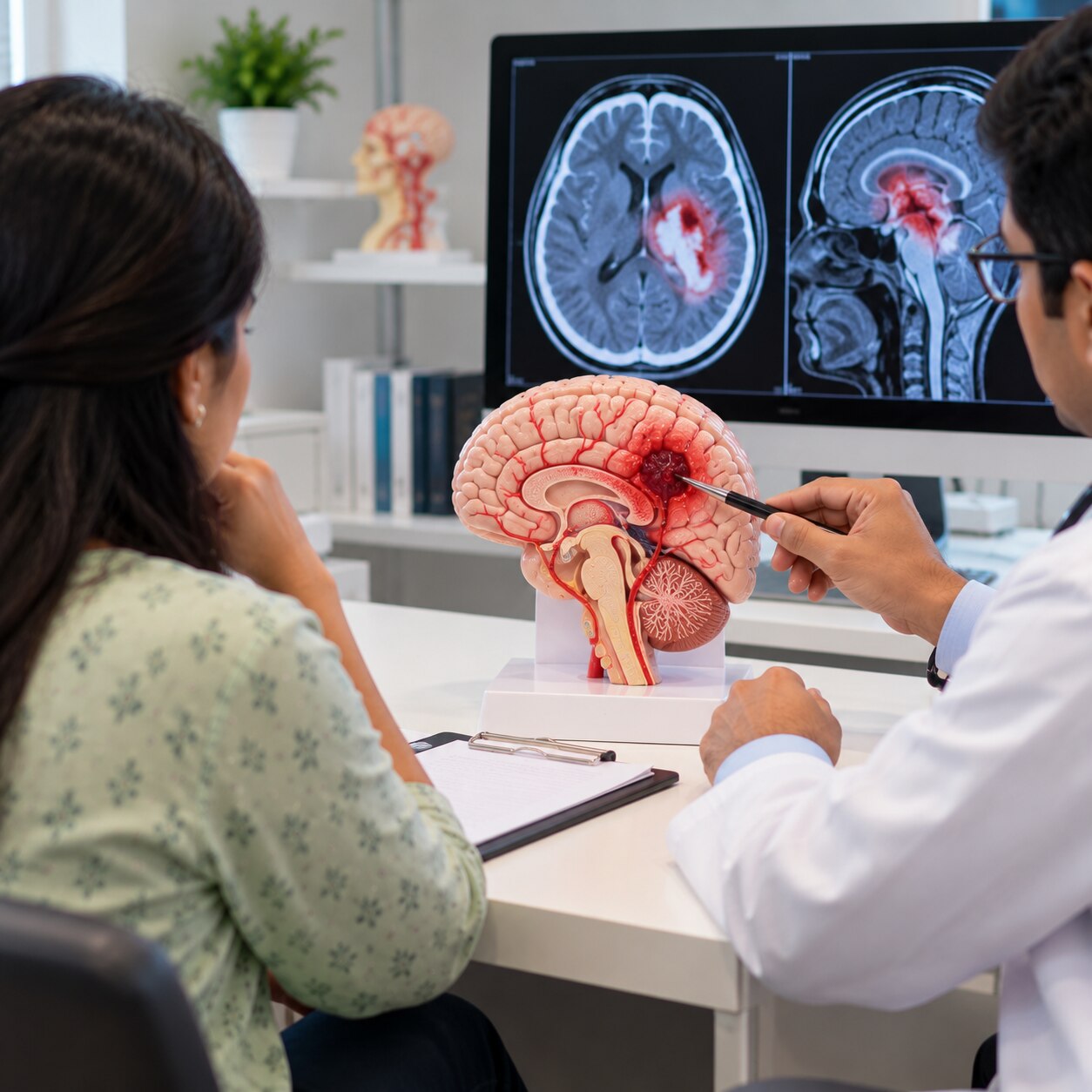
Suspected bleeding in or around the brain is an emergency, not a condition to evaluate through a routine outpatient appointment. You will learn how to recognise the warning signs, what to do before transport, how Mumbai hospitals investigate the bleed, and which factors guide medical treatment, intensive care or surgery.
Key takeaways
- Call 112 immediately for sudden weakness, severe headache, seizures or reduced consciousness.
- Do not drive a deteriorating patient to hospital yourself.
- Ask which type of bleed was diagnosed and whether surgery is necessary.
- Request clear recovery goals, warning signs and follow-up arrangements before discharge.
Recognise the Type of Brain Bleed and Call an Ambulance
A suspected brain haemorrhage requires immediate hospital treatment, not routine outpatient assessment. Call Mumbai’s emergency number, 112, for sudden severe headache, facial drooping, one-sided weakness or numbness, slurred speech, vomiting, seizure, loss of balance, confusion or reduced consciousness. Do not drive a deteriorating patient yourself.
“Is brain hemorrhage treatment right for my family in mumbai” cannot be answered until doctors identify the bleed and its cause. Intracerebral haemorrhage is bleeding within brain tissue; subarachnoid haemorrhage often follows a ruptured aneurysm; a subdural haematoma collects beneath the outer brain covering, usually after trauma.
An epidural haematoma, arteriovenous malformation or tumour requires a different plan.
1. Note the exact symptom start time, or the last time the person was known to be well. Tell the ambulance team and hospital.
2. Keep the person on their side if unconscious but breathing. Watch breathing continuously, and do not leave them alone.
3. Give no food, drink or aspirin. Do not force tablets into someone who is drowsy, vomiting or unable to swallow.
4. Take the medication list, especially warfarin, apixaban, rivaroxaban, dabigatran, aspirin or clopidogrel, along with identification and medical records.
The first emergency scan is usually a rapid non-contrast CT of the head. Ask which type, location and volume of bleeding was found, and whether pressure, hydrocephalus or blood inside the ventricles requires transfer to a centre with stroke, neurosurgery and neurocritical-care services.
What Happens in a Mumbai Emergency Department
A non-contrast CT head is usually the first decisive test because it quickly shows fresh blood, its location and mass effect. Doctors also check blood pressure, blood glucose, oxygen, temperature, medication use and clotting results, including platelet count, prothrombin time and INR.
A neurological examination records speech, limb strength, pupils, alertness and Glasgow Coma Scale score.
| Finding on assessment | Test or specialist that clarifies it | Why urgency changes |
|---|---|---|
| Blood inside brain tissue | CT; neurologist or stroke physician | Pressure, expansion and reduced consciousness may require neurocritical care or neurosurgery |
| Blood around the brain, suggesting aneurysm | CT angiography; interventional neuroradiologist | Coiling or another aneurysm treatment may be time-critical |
| Blood beneath the skull after injury | CT; neurosurgeon | A large clot or compressed brain may need urgent evacuation |
| Unclear source, vascular malformation or tumour | CT angiography, MRI or catheter angiography | The cause determines monitoring, embolisation, surgery or another plan |
A repeat CT detects expansion, hydrocephalus or worsening swelling. MRI is useful when the first scan does not explain the symptoms, but it must not delay emergency stabilisation. EEG may be ordered for a seizure, unexplained fluctuating consciousness or confusion.
A brain hemorrhage doctor in Mumbai is not the only decision-maker. Ask whether a neurologist, neurosurgeon, interventional neuroradiologist and neurointensivist are available continuously, and whether the patient can reach a stroke unit or neurocritical-care bed without delay. The diagnosis must name the bleed type before your family compares treatments.
Medical Treatment and Neurocritical Care Without an Operation
The first decision is not “operation or no operation”; it is identifying the bleed. Intracerebral haemorrhage, subarachnoid haemorrhage, subdural or epidural bleeding, and bleeding from an arteriovenous malformation or tumour require different plans. Ask which diagnosis the CT or MRI supports.
| Diagnosis | Non-operative treatment while stabilising |
|---|---|
| Intracerebral haemorrhage | Care in a stroke unit or neurocritical-care unit, frequent neurological checks, controlled blood pressure, repeat CT, airway support, and reversal of blood thinners when indicated |
| Subarachnoid haemorrhage | Blood-pressure control, nimodipine when prescribed, seizure treatment when indicated, and close monitoring for rebleeding, hydrocephalus or reduced consciousness |
| Subdural or epidural bleeding | Observation with repeated neurological examinations and imaging only when the collection is small and the patient remains stable |
| Vascular malformation or tumour-related bleed | Stabilisation, pressure management, seizure control when needed, and vascular or tumour imaging to plan definitive treatment |
These are important brain bleed treatment options in Mumbai when surgery is not immediately required. Doctors may also treat fever, low oxygen, abnormal glucose, raised pressure inside the skull and swallowing problems. Routine open craniotomy has uncertain benefit for many supratentorial bleeds, while selected minimally invasive evacuation may be considered.
Cerebellar bleeding with deterioration, brainstem compression or obstructive hydrocephalus needs urgent neurosurgical review.
Confirm that the hospital has continuous access to a neurologist, neurosurgeon, neurointensivist, repeat imaging and airway support. A smaller hospital may stabilise the patient before transfer. Recovery planning begins during admission, including swallowing assessment and rehabilitation once neurological stability returns.
When Doctors Consider Drainage, Craniotomy or Vascular Treatment
Choice turns on the bleeding site, volume, pressure effects and neurological examination—not the scan alone. A small, stable supratentorial intracerebral haemorrhage may receive close monitoring and medical treatment. Routine open craniotomy has uncertain benefit for many such bleeds, while selected patients may benefit from minimally invasive clot evacuation.
- External ventricular drainage: Doctors place a temporary catheter when blood blocks cerebrospinal-fluid flow, causing hydrocephalus or declining consciousness. It relieves pressure but does not remove the main clot, so ask whether hydrocephalus is driving the deterioration.
- Minimally invasive evacuation: A catheter-based or keyhole procedure may suit a selected large, accessible intracerebral haemorrhage when pressure or neurological decline outweighs procedural risk.
- Open craniotomy: Urgent removal is recommended for a cerebellar bleed with deterioration, brainstem compression or obstructive hydrocephalus, especially at a volume around 15 mL or more. The posterior fossa has little spare space.
- Vascular treatment: A ruptured aneurysm causing subarachnoid haemorrhage needs urgent sealing with endovascular coiling or surgical clipping. Bleeding from an arteriovenous malformation requires vascular imaging and a separate treatment plan.
Very low consciousness, herniation, worsening weakness or a large bleed can support intervention, but a poor early score must not alone end life-sustaining treatment. Doctors also consider anticoagulant use, previous wishes and reversible injury.
Brain bleed treatment options in Mumbai should involve clear responsibility across neurology, neurosurgery, neurointerventional care and neurocritical care. Dr. Sachin Adukia can help interpret the neurological decision, but confirm which hospital team can provide continuous surgical and intensive-care support.
Related services
Brain Hemorrhage Treatment Dr. Sachin Adukia is a highly experienced neurologist specializing in the diagnosis and advanced treatment of brain hemorrhage and other critical... View service → |
Stroke Management Dr. Sachin Adukia offers comprehensive and advanced Stroke Management services with a strong focus on timely diagnosis, emergency care, and long-term... View service → |
How Families Should Judge the Plan and Prepare for Recovery
Before consenting to a procedure or transfer, ask the team to name the bleed: intracerebral haemorrhage, subarachnoid haemorrhage, subdural haematoma, or bleeding from an arteriovenous malformation or tumour. The diagnosis, location, volume, hydrocephalus and consciousness level determine the plan—not the label “brain haemorrhage” alone.
- What is the immediate goal: controlling blood pressure, reversing a blood thinner, reducing pressure, draining fluid, removing clot, or treating an aneurysm?
- What happens if we monitor instead, and what specific change would trigger surgery or vascular treatment?
- What are the major risks of this option, including rebleeding, infection, seizures, stroke, disability and complications from prolonged ventilation?
- Which specialists are directly involved: a neurologist or stroke physician, neurosurgeon, neurointensivist, and interventional neuroradiologist? Are neurocritical care, repeat CT imaging, airway support and emergency surgery available continuously?
- What does the neurological examination show, which injuries appear reversible, and when will the team reassess the prognosis? Do not base life-sustaining decisions on an early score alone.
- Before discharge, who will arrange physiotherapy, occupational therapy, speech and language therapy, swallowing assessment, and cognitive or psychological care?
- How will you prevent another haemorrhage through blood-pressure targets, medication review and treatment of the underlying cause?
For brain hemorrhage care for family in Mumbai, request a written discharge plan with warning signs, follow-up dates, medication instructions and rehabilitation contacts. Recovery planning should begin during admission, then adapt as strength, speech, swallowing and thinking improve.
Frequently asked questions
When should I call an ambulance for a suspected brain haemorrhage in Mumbai?
Call 112 immediately for sudden severe headache, facial drooping, one-sided weakness or numbness, slurred speech, vomiting, seizure, loss of balance, confusion or reduced consciousness. Do not drive a deteriorating patient yourself.
What happens in a Mumbai emergency department after a suspected brain bleed?
The emergency team assesses consciousness, speech, movement and vital signs, then uses brain imaging to identify the bleed and guide urgent treatment.
Can a brain haemorrhage be treated without an operation?
Yes. Medical treatment and neurocritical care can include close monitoring, management of blood pressure and brain pressure, seizure treatment, and support for breathing and other body functions.
When might doctors recommend drainage, craniotomy or vascular treatment?
Doctors consider these procedures according to the bleed’s location and size, pressure on the brain, the patient’s condition and the underlying blood-vessel problem.
How can families judge a brain haemorrhage treatment plan?
Ask which type of bleed occurred, what each treatment aims to achieve, why an operation is or is not recommended, what recovery involves, and which warning signs require urgent review.
Keywords