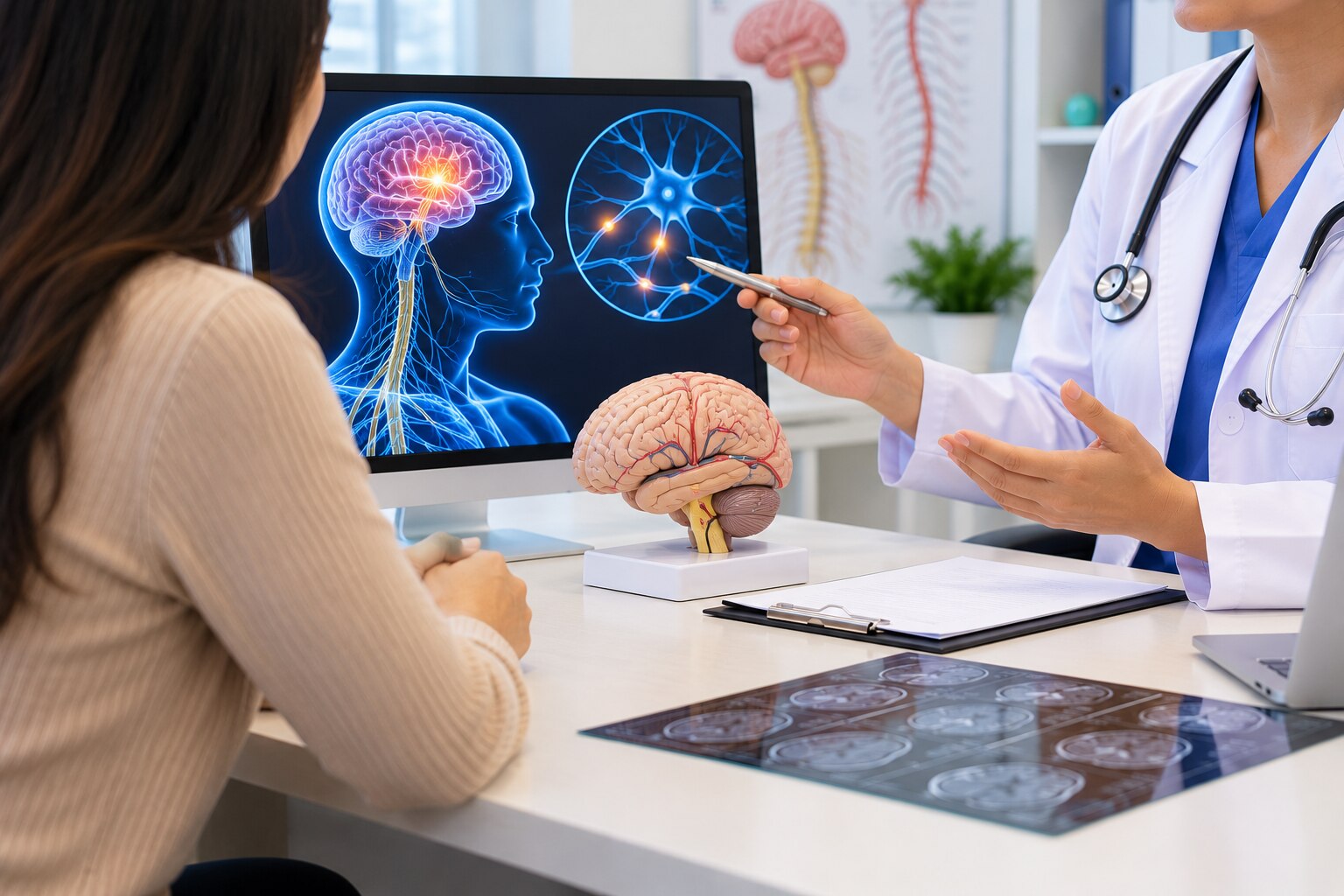
Weakness, vision loss, seizures, confusion or swallowing difficulty can arise from several neurological conditions, and the right treatment depends on identifying the specific syndrome rather than assuming every problem is autoimmune. By the end, you will know which disorders belong to autoimmune neurology, what testing involves, when treatment is urgent, and what safe long-term follow-up should include.
Key takeaways
- Seek urgent assessment for new weakness, seizures, confusion, vision loss or breathing difficulty.
- Diagnosis combines symptoms, neurological examination, MRI, blood tests and sometimes cerebrospinal fluid analysis.
- Acute treatment controls active inflammation; relapse prevention reduces the risk of future attacks.
- Track new symptoms, treatment effects and recovery between specialist appointments.
Which conditions belong to autoimmune neurology, and which symptoms need urgent assessment?
Autoimmune neurology covers disorders in which the immune system attacks the brain, spinal cord, nerves or neuromuscular junction. The main syndromes are multiple sclerosis, neuromyelitis optica spectrum disorder (NMOSD), MOG-antibody disease, autoimmune encephalitis, autoimmune neuropathies and myasthenia gravis.
An autoimmune neurology doctor in Mumbai must match the symptoms to the syndrome before choosing tests or treatment.
| Condition | Main pattern | Urgent concern |
|---|---|---|
| Multiple sclerosis | Episodes affecting vision, sensation, strength, coordination or spinal pathways | New severe weakness, vision loss or loss of balance |
| NMOSD | Severe optic neuritis or spinal-cord inflammation | Major vision loss or rapidly worsening paralysis |
| MOG-antibody disease | Optic neuritis, myelitis or brain inflammation | Severe vision change, weakness or confusion |
| Autoimmune encephalitis | Seizures, confusion, memory loss or personality change | Seizures, reduced awareness or dangerous behaviour |
| Autoimmune neuropathy | Progressive numbness or weakness in peripheral nerves | Rapidly ascending weakness or breathing difficulty |
| Myasthenia gravis | Fluctuating eyelid, speech, swallowing or limb weakness | Difficulty swallowing or breathing, suggesting myasthenic crisis |
Seek emergency neurological assessment for rapidly progressive weakness, new vision loss, seizures, confusion, personality change, difficulty swallowing or breathing, or sudden loss of balance. These symptoms can also result from infection, migraine, epilepsy, degenerative disease, stroke or a structural brain or spinal disorder; symptoms alone cannot establish an autoimmune cause.
Doctors use examination, MRI, cerebrospinal-fluid analysis, antibody testing, nerve studies and electromyography to separate these possibilities.
How is an autoimmune neurological disorder confirmed?
Confirmation starts with a neurological examination, not an antibody result. The clinician checks strength, reflexes, sensation, eye movements and vision, then coordination, gait, cognition, speech, swallowing and breathing. This pattern identifies the syndrome and severity before testing. Doctors also screen for infection, cancer, toxic-metabolic disease, seizures and structural disorders when these mimics fit the presentation.
- MRI of the brain or spine looks for inflammation, demyelination, swelling, compression and other lesions.
- Cerebrospinal-fluid analysis measures cells, protein, infection markers and oligoclonal bands.
- EEG is useful when seizures or encephalopathy could explain confusion, memory change or abnormal behaviour.
- Targeted antibody testing uses serum, CSF or both. The useful antibodies differ between conditions.
- Nerve-conduction studies and electromyography assess autoimmune neuropathy, myasthenia gravis and muscle or nerve dysfunction.
| Finding | What it means | What it does not prove |
|---|---|---|
| Positive antibody | Supports a compatible autoimmune syndrome | A low-positive result from an indiscriminate panel cannot establish causation |
| Negative antibody panel | Fails to identify a tested antibody | Does not exclude disease; sensitivity varies by condition, timing, specimen and assay |
| Possible multiple sclerosis | Requires lesions disseminated in space and time | One MRI lesion or one positive oligoclonal-band result is insufficient |
| Compatible MOG-IgG result | Supports MOG-antibody disease when confirmed by a validated cell-based assay | A low-positive result without a matching clinical and MRI picture can mislead |
Diagnosis therefore combines examination, test findings and exclusion of alternatives—not a single report.
How do doctors choose acute treatment and relapse prevention?
An active attack needs rapid treatment; maintenance therapy reduces the chance of another attack. High-dose intravenous corticosteroids are commonly used first for inflammatory attacks. Intravenous immunoglobulin (IVIG) or plasma exchange is considered when the attack is severe, steroids are unsuitable, or the response is inadequate.
| Treatment | What it does | When it is considered |
|---|---|---|
| Intravenous corticosteroids | Suppresses acute inflammation | First-line treatment for many attacks |
| IVIG | Modulates harmful immune activity | Selected attacks, including some neuropathies and myasthenia gravis |
| Plasma exchange | Removes circulating antibodies and other plasma factors | Severe attacks or poor response to initial treatment; requires vascular access and monitoring for hypotension, bleeding, infection and electrolyte abnormalities |
| Rituximab or another immune therapy | Reduces future immune attacks | Relapse prevention or severe, treatment-resistant disease |
Plasma exchange is not another form of IVIG. It replaces filtered plasma and carries procedure-specific risks. Severe autoimmune encephalitis may require treatment before every result returns when clinical suspicion is high, after cultures, cerebrospinal-fluid and other essential infection samples are obtained where feasible.
Choosing autoimmune neurological disorder treatment in Mumbai starts with the correct diagnosis. NMOSD must not be treated as typical MS: some MS disease-modifying therapies are unsuitable and can worsen outcomes. MOG-antibody disease requires validated cell-based MOG-IgG testing.
Autoimmune neuropathy, myasthenia gravis and MS each have different maintenance plans, including when rituximab or other immune therapies fit. Do not stop steroids or immune therapy abruptly; relapse or rebound can follow.
What does ongoing specialist care involve after the first treatment?
After first treatment, ongoing care measures whether you are functioning better, relapsing, or developing treatment toxicity—not merely whether an MRI looks stable. Record attack dates and triggers, vision, walking, strength, fatigue, cognition, seizure control, swallowing, breathing, missed doses and adverse effects; stable scans do not prove that symptoms or disability have resolved.
Monitoring depends on the therapy and diagnosis. Ask whether your plan includes:
- Blood counts, liver tests and glucose checks
- Infection screening, vaccination planning and advice about exposure risks
- Bone protection during prolonged steroid treatment
- Reproductive counselling before immunotherapy, pregnancy or fertility treatment
- Repeat MRI, cerebrospinal fluid or blood tests only when the result could change management
A neurologist for autoimmune disease in Mumbai should explain how follow-up differs between these conditions:
| Condition | Follow-up focus | Useful question |
|---|---|---|
| Multiple sclerosis | New attacks, disability, MRI activity and treatment safety | How will you measure progression beyond MRI? |
| NMOSD or MOG-antibody disease | Vision, spinal-cord function and relapse prevention | How will you avoid applying an unsuitable MS treatment? |
| Encephalitis, neuropathy or myasthenia gravis | Cognition, seizures, strength, swallowing and breathing | Who reviews urgent deterioration? |
Readers considering Dr. Sachin Adukia can ask about experience distinguishing these diagnoses, and how urgent review, infusion monitoring, rehabilitation and coordination with ophthalmology, immunology, respiratory medicine or other specialists are arranged. Rescue plans matter because waiting for a routine appointment can be unsafe when swallowing or breathing worsens.
Related services
Autoimmune Neurological Disease Treatment Autoimmune Neurological Disease Treatment Dr. Sachin Adukia is a trusted and experienced Neurologist providing comprehensive diagnosis and advanced treatment for autoimmune neurological... View service → |
Neurology Infusion Therapy Neurology Infusion Therapy is an advanced treatment approach used to manage various neurological disorders through the controlled administration of... View service → |
How can you tell a relapse from a side effect or another problem?
A relapse is not diagnosed by symptom intensity alone. Before changing medication, date the onset and describe the change, then check what else was happening.
1. Record fever, cough, urinary symptoms, diarrhoea, sick contacts, heat exposure, poor sleep, unusual exertion and missed doses. Heat can temporarily worsen old MS symptoms and fatigue without new inflammatory activity.
2. Note recent infusions, steroid doses, dose reductions and new medicines. Steroids can cause insomnia, mood change and high glucose; immune therapies can increase infection risk or cause an infusion reaction.
3. Treat infection as a separate possibility. It can cause weakness, confusion or seizures and needs assessment and treatment rather than an automatic steroid increase.
4. Remember other emergencies and mimics, including stroke, spinal or nerve compression, seizure, metabolic illness and another neurological disorder. A new symptom deserves examination and appropriate tests before it is labelled a relapse.
5. Contact your treating specialist before increasing, stopping or tapering treatment. Unnecessary steroids carry harm, while delaying alternative care can worsen the real problem.
Go to emergency care for breathing or swallowing difficulty, rapidly progressive weakness, a prolonged or repeated seizure, severe confusion, new major vision loss or inability to walk safely. The aim is to confirm disease activity while checking treatment toxicity and other causes.
Frequently asked questions
Which conditions belong to autoimmune neurology?
Autoimmune neurology includes multiple sclerosis, neuromyelitis optica spectrum disorder, MOG-antibody disease, autoimmune encephalitis, autoimmune neuropathies and myasthenia gravis. Urgent assessment is needed for new weakness, seizures, confusion, vision loss, swallowing difficulty or breathing problems.
How is an autoimmune neurological disorder confirmed?
Doctors combine the symptom pattern and neurological examination with tests such as MRI, antibody blood tests and, when indicated, cerebrospinal fluid analysis. They also exclude infections, metabolic disorders, medication effects and other conditions that can resemble autoimmunity.
How do doctors choose acute treatment and relapse prevention?
Treatment depends on the affected part of the nervous system, attack severity, test results, previous relapses and other health conditions. Acute therapy targets active inflammation, while longer-term treatment reduces the risk of further attacks and requires safety monitoring.
What does ongoing specialist care involve after the first treatment?
Follow-up care tracks strength, vision, thinking, sensation, walking, swallowing and fatigue alongside medication effects and test results. Your neurologist adjusts treatment when recovery is incomplete, side effects appear or relapse risk changes.
How can you tell a relapse from a side effect or another problem?
A relapse usually causes new or clearly worsening neurological symptoms that persist and fit the diagnosed disorder. Side effects often follow a treatment change and match the medicine's known effects, while fever, infection, poor sleep or metabolic problems can worsen old symptoms. Contact your neurologist rather than changing treatment yourself.
Keywords