A suspected brain haemorrhage needs emergency transport, rapid CT imaging and treatment matched to the location, cause and size of the bleed. You will learn which symptoms require a 112 call, what information to take to hospital, how doctors distinguish bleeding from an ischaemic stroke, and how to compare emergency facilities in Mumbai.
Key takeaways
- Call 112 immediately and record when symptoms began.
- CT brain imaging usually confirms bleeding quickly.
- Do not give food, drink or medicines unless emergency staff advise it.
- Treatment may involve monitoring, surgery, coiling or blood-pressure control.
Recognise the warning signs and call 112 immediately
A brain haemorrhage needs emergency care when symptoms start suddenly, worsen quickly, or include a new neurological deficit. Call 112 in Mumbai and request an ambulance; do not arrange a routine appointment with a neurologist. Note the exact onset time, or when the person was last known to be well.
Call immediately for any of these signs:
- Facial drooping, weakness, or numbness on one side
- Slurred speech, inability to understand words, confusion, or sudden vision loss
- Loss of balance, difficulty walking, collapse, or reduced alertness
- A sudden, severe headache, especially with repeated vomiting or neck stiffness
- A seizure, including a first seizure or one followed by failure to regain consciousness
Symptoms alone cannot distinguish a brain bleed from an ischaemic stroke. Clot-busting treatment used for some ischaemic strokes can be dangerous when bleeding is present, so urgent brain imaging must come before that decision. Do not drive an unstable patient yourself; ambulance transport allows faster assessment and safer transfer to emergency care.
| Situation | Action | Reason |
|---|---|---|
| Sudden neurological symptoms | Call 112 and go to an emergency department | Brain hemorrhage treatment in Mumbai starts with immediate imaging and stabilisation |
| Collapse, seizure, or reduced consciousness | Keep the person safe and await the ambulance | Airway, breathing, and pressure complications need urgent monitoring |
| Long-standing, unchanged symptoms | Book a routine neurology appointment | No sudden warning sign is present |
How doctors confirm the type and cause of bleeding
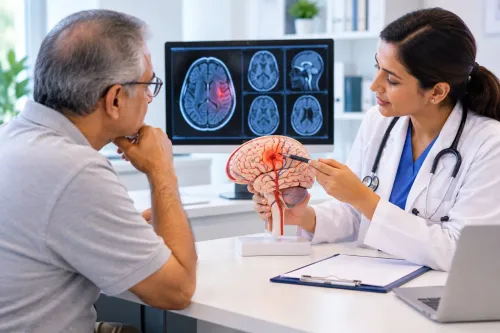
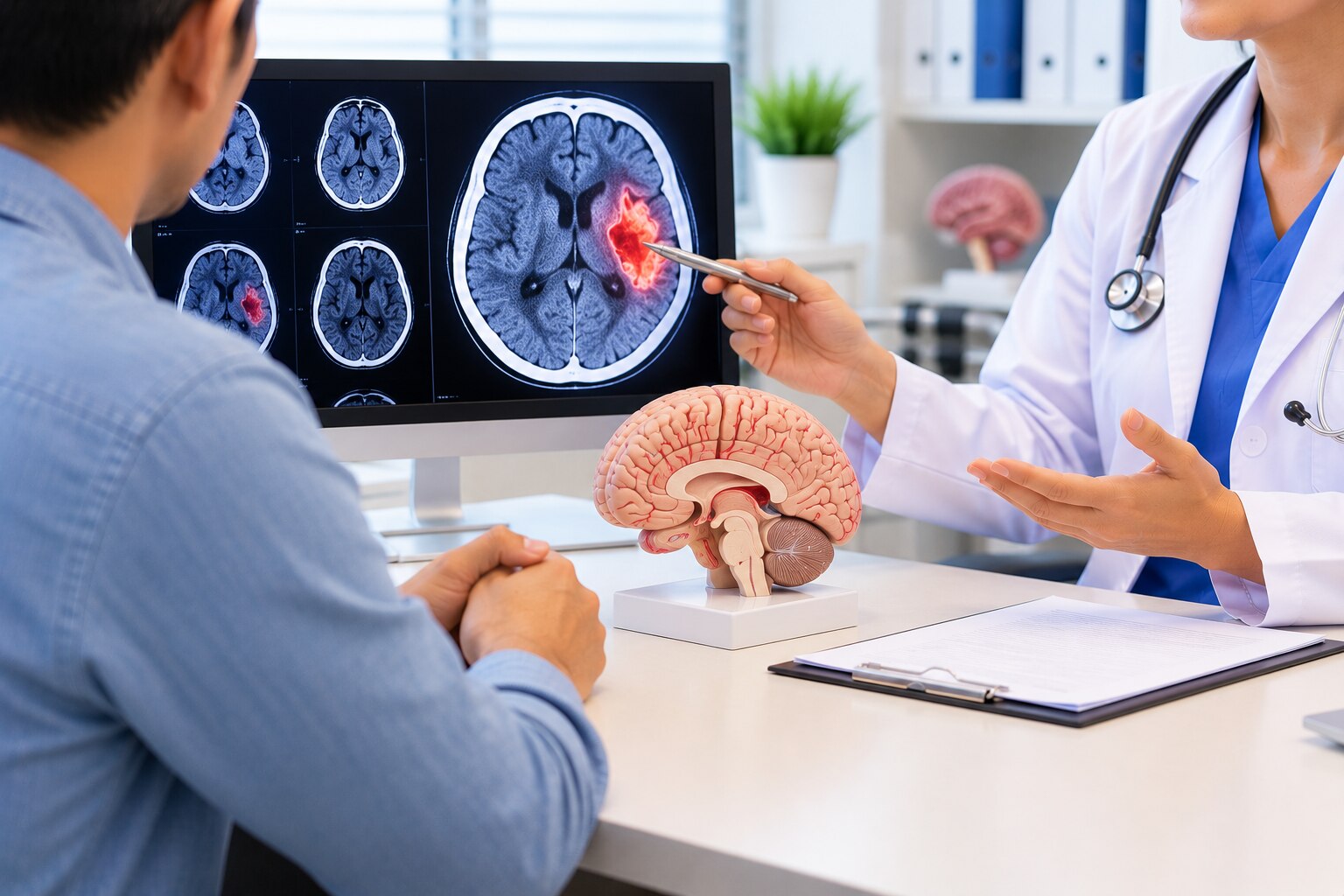
A non-contrast CT scan is usually the first decisive test: it shows whether blood is present, how much has collected and where it sits. Doctors match that pattern to the likely diagnosis, then choose tests that reveal the source.
| Type of bleed | Where blood collects | Scan or test that identifies it |
|---|---|---|
| Intracerebral haemorrhage | Within brain tissue | Non-contrast CT; MRI with susceptibility-sensitive sequences can clarify age, location and underlying lesions |
| Subarachnoid haemorrhage | In the space around the brain | CT; CT angiography (CTA) looks for a ruptured aneurysm, followed by catheter angiography when needed |
| Subdural haematoma | Between the dura and arachnoid membranes | Non-contrast CT, which shows acute blood and pressure on the brain |
| Epidural haematoma | Between the skull and dura | Non-contrast CT, often revealing a lens-shaped collection and skull fracture |
| Haemorrhagic transformation | Bleeding into an area of ischaemic stroke | CT confirms blood; MRI defines the infarct, while CTA assesses blocked or abnormal vessels |
CTA uses injected contrast to map arteries quickly. Digital subtraction angiography uses a catheter and gives a detailed view when an aneurysm or arteriovenous malformation remains uncertain. MRI helps when CT is inconclusive or a tumour, cavernoma or old bleed is suspected.
For brain bleed treatment in Mumbai, doctors also check blood pressure, platelet count, clotting results, kidney function and medicines such as warfarin or apixaban. Do not give aspirin, ibuprofen, anticoagulants, thrombolysis or leftover blood-pressure tablets until imaging directs treatment.
What happens during the first hours of hospital treatment
Once CT or MRI confirms bleeding, the team stabilises breathing, circulation and brain pressure while identifying the source. There is no single “brain bleed” medicine: an intracerebral haemorrhage, aneurysmal subarachnoid haemorrhage and a subdural haematoma need different decisions.
Doctors may use:
- Intravenous blood-pressure medicine to lower dangerously high pressure without reducing brain perfusion.
- Drug-specific reversal treatment for anticoagulants, such as vitamin K with four-factor prothrombin complex concentrate for warfarin, or idarucizumab for dabigatran.
- Anti-seizure medicine when a seizure occurs or monitoring shows seizure activity.
- An external ventricular drain when blood blocks fluid circulation and causes hydrocephalus or rising pressure.
- Neurosurgical evacuation or decompression when the clot compresses the brain or threatens herniation.
- Endovascular coiling or surgical clipping for a ruptured aneurysm causing subarachnoid haemorrhage.
A ruptured aneurysm needs specialist neurovascular treatment, preferably within 24 hours when feasible, because leaving it unsecured risks rebleeding. The patient therefore needs continuous neurological observation, repeat imaging when indicated and access to neurocritical care, neurosurgery and endovascular treatment.
A brain hemorrhage treatment in Mumbai pathway should provide these capabilities without a risky transfer that delays stabilisation.
When surgery, coiling or intensive monitoring is needed
A brain bleeding treatment hospital in Mumbai should be judged by what it can deliver within minutes, not by the word “neurologist” on its signboard. Ask whether it has immediate CT, continuous neurological monitoring, intensive care, anticoagulant reversal, neurosurgical review, and 24-hour access to coiling or clipping.
Moving an unstable patient between hospitals can worsen the outcome if imaging or stabilisation is delayed.
| Option | What it means | When it applies |
|---|---|---|
| Medical monitoring | Blood pressure control, reversal of blood thinners, seizure treatment and repeated neurological checks in intensive care | The bleed is stable, pressure is controlled and there is no dangerous compression or treatable aneurysm |
| External ventricular drain | A tube drains cerebrospinal fluid and measures pressure | Blood blocks fluid pathways, causing hydrocephalus or rising pressure |
| Surgical evacuation or decompression | Surgeons remove blood or open the skull to relieve pressure | A large or accessible clot compresses the brain, the patient deteriorates, or pressure threatens survival |
| Coiling or clipping | Neurointerventional specialists seal a ruptured aneurysm from inside the artery or with surgery | Subarachnoid haemorrhage caused by an aneurysm; securing it within 24 hours is preferred when feasible |
A patient who is awake and stable still needs specialist review because a scan can reveal a lesion that will expand. Ask who will coordinate neurology, neurosurgery, neurointervention and neurocritical care, and how quickly the team can act if consciousness, pupils, strength or breathing changes.
Recovery, follow-up and choosing neurological expertise
Discharge is not the end of care. Arrange review to control blood pressure, identify why the bleeding occurred, check medication risks and monitor for seizures, hydrocephalus, recurrent symptoms or cognitive changes.
A brain hemorrhage neurologist in Mumbai should be involved before discharge when the cause remains uncertain, symptoms fluctuate or the patient needs coordinated specialist follow-up.
Recovery plans should address:
- Swallowing and nutrition, especially after coughing during meals or a weak gag
- Speech, memory, attention, mood and vision
- Walking, arm use, balance and everyday tasks such as bathing and dressing
- Safe rehabilitation, increased gradually after medical stabilisation; overly intensive mobilisation too early can worsen recovery after intracerebral haemorrhage
- Blood-pressure readings, prescribed medicines and warning signs that require immediate return to hospital
Dr. Sachin Adukia can review neurological recovery, seizure risk, blood-pressure management and the need for rehabilitation or further testing after discharge.
| Facility or specialist pathway | What it provides | When it applies |
|---|---|---|
| Emergency hospital with neurocritical care | Immediate CT, continuous neurological monitoring, intensive care and anticoagulant reversal | Ongoing weakness, reduced consciousness, seizures, dangerous blood pressure or suspected pressure |
| Neurovascular-capable hospital | Neurosurgical review plus aneurysm coiling or clipping | Subarachnoid haemorrhage from a ruptured aneurysm; securing it within 24 hours is recommended when feasible |
| Outpatient neurology follow-up | Cause investigation, medication review and recovery planning | Stable patients after emergency treatment, not people with new or worsening symptoms |
Travel between facilities can be dangerous if it delays imaging or stabilisation, so confirm inter-hospital ambulance coordination before transfer.
Related services
Brain Hemorrhage Treatment Dr. Sachin Adukia is a highly experienced neurologist specializing in the diagnosis and advanced treatment of brain hemorrhage and other critical... View service → |
Stroke Management Dr. Sachin Adukia offers comprehensive and advanced Stroke Management services with a strong focus on timely diagnosis, emergency care, and long-term... View service → |
Frequently asked questions
When should you call 112 for a suspected brain haemorrhage?
Call 112 immediately when symptoms begin suddenly, worsen quickly or include a new neurological deficit. Record the exact onset time, or when the person was last known to be well.
How do doctors confirm the type and cause of a brain bleed?
Doctors use urgent brain imaging, usually a CT scan, to locate bleeding. Additional imaging and blood tests help identify the bleeding pattern, blood-vessel cause, medication effects and other risks.
What happens during the first hours of brain haemorrhage treatment?
The team stabilises breathing and circulation, checks consciousness and neurological function, controls blood pressure when indicated, reviews medicines such as anticoagulants and arranges urgent imaging.
When is surgery or coiling needed for a brain haemorrhage?
Neurosurgery or endovascular treatment is considered when bleeding creates dangerous pressure, a vessel has an aneurysm or malformation, or the patient’s condition requires the bleeding source to be secured. Intensive monitoring is used when complications remain a risk.
What does recovery and follow-up involve after a brain bleed?
Follow-up can include repeat scans, blood-pressure management, medication review and rehabilitation for movement, speech, swallowing, thinking or emotional changes. A neurologist coordinates ongoing care with other specialists.
Keywords