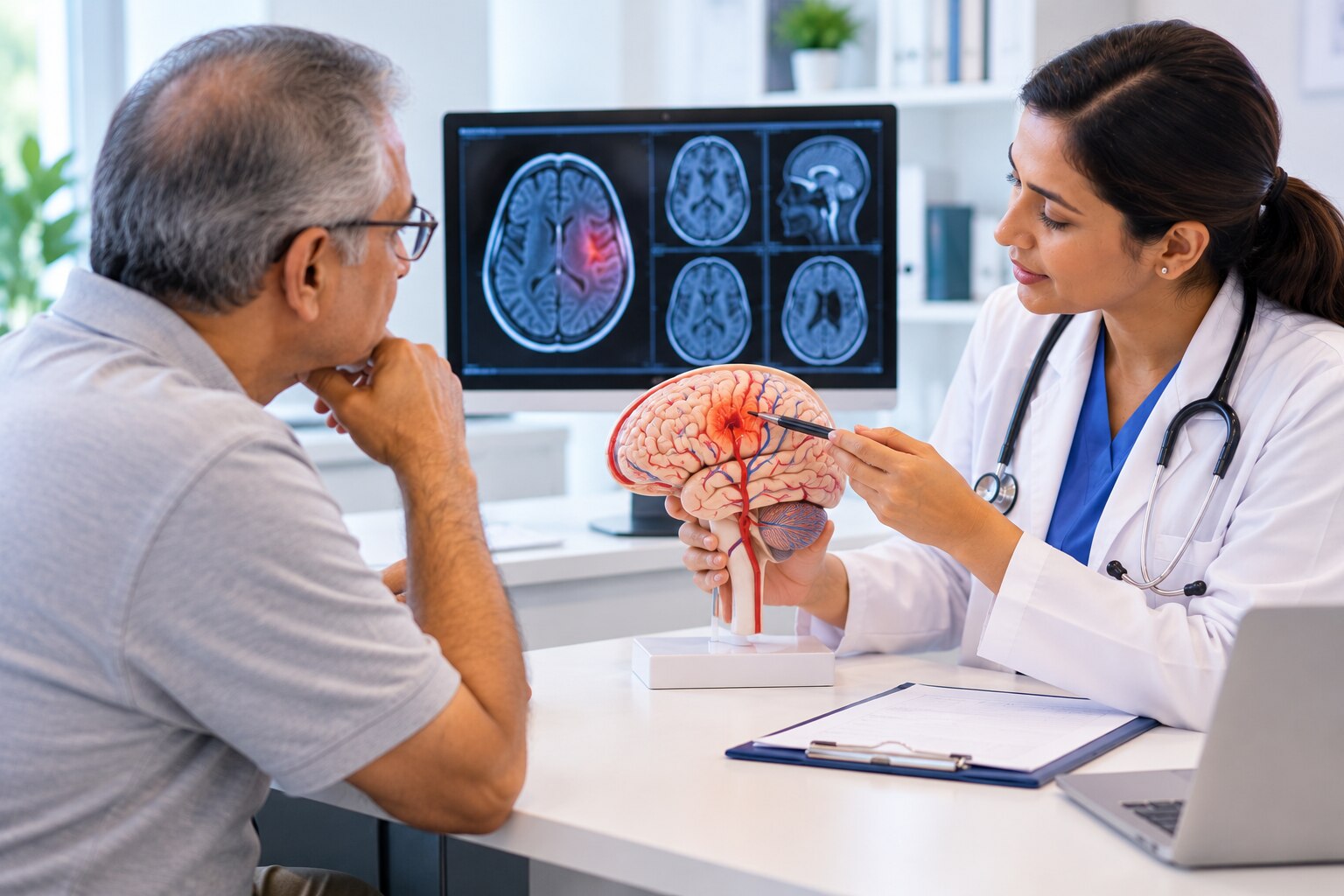
Leaving hospital after a stroke starts a second phase of care: confirming the diagnosis, preventing another event, checking medicines, and rebuilding safe independence. You will know what to request at discharge, when to arrange reviews, how rehabilitation fits in, and which symptoms require emergency help rather than a routine appointment.
Key takeaways
- Leave hospital with the stroke type, cause, medicines and follow-up date documented.
- Prepare every visit with symptom changes, blood-pressure readings and an updated medicine list.
- Start rehabilitation for swallowing, movement, speech, thinking and emotional changes.
- Treat new weakness, speech trouble, vision loss or severe headache as an emergency.
What should be in a stroke plan before you leave hospital?
Before leaving hospital, you need a written plan for what happens after emergency stroke treatment, not merely a prescription and a scan appointment. Emergency care focuses on urgent CT or MRI, stabilisation and acute interventions; post-discharge management confirms the stroke type and cause, reviews brain and vessel-imaging results, prevents recurrence and tracks recovery.
That is what does stroke management cover after emergency treatment in Mumbai.
1. Record the written diagnosis, suspected cause, CT or MRI findings, and angiography findings when performed.
2. Confirm the swallowing result. If the patient has not passed a swallowing screen, do not routinely give food, drink or oral medicines until the clinical team provides safe instructions. Write down approved food textures, fluid instructions and feeding supervision requirements.
3. List every medicine, dose and timing, along with blood-pressure and lipid targets. Include who to contact about missed doses or side effects.
4. Describe functional deficits, mobility restrictions and falls precautions. Add referrals for physiotherapy, occupational therapy, speech-and-language therapy or other rehabilitation.
5. Write the next review date, warning signs and contact details for the hospital team. New facial droop, limb weakness, speech difficulty, sudden vision loss, severe imbalance or a sudden severe headache requires emergency assessment.
The plan should also name who coordinates care between the Mumbai hospital, rehabilitation centre, neurologist and home services. Follow-up begins at discharge, even before the first outpatient appointment.
When should follow-up begin, and how should you prepare for each visit?
Follow-up begins before discharge: confirm the written plan, then book the first neurologist review for the date specified by the treating team. For families arranging stroke follow up care in Mumbai, continuity starts with a clear handover from hospital to home.
1. Before leaving, record the stroke type and suspected cause, medication doses and times, swallowing and diet instructions, rehabilitation referrals, blood-pressure and lipid targets, warning signs, and the name and phone number of the care coordinator.
2. At the first review, bring the discharge summary, CT or MRI reports and image discs, angiography reports, medication strips or a complete medicine list, recent blood-pressure readings, glucose records, and a written list of new symptoms. This visit checks hospital complications, medication safety, kidney function, bleeding risk where relevant, swallowing, and early functional progress.
3. At later reviews, the focus shifts to recovery milestones, blood-pressure, glucose and cholesterol targets, rehabilitation goals, falls, mood, cognition and long-term adherence. Ask when the patient can consider work, driving or independent activities; walking improvement alone does not establish readiness.
4. Keep one named coordinator when care moves between the emergency hospital, rehabilitation centre, local neurologist and home-based services. Give that person updated reports and therapist recommendations so medication changes and rehabilitation goals do not conflict.
Take sudden new weakness, facial droop, speech difficulty, vision loss, severe imbalance or a severe headache to emergency care rather than waiting for the next appointment.
How do medicines and prevention change after different types of stroke?
After an ischaemic stroke, medication depends on its cause. Most non-cardioembolic strokes use an antiplatelet drug; an atrial-fibrillation-related stroke requires assessment for anticoagulation. These treatments are not interchangeable. Dual antiplatelet therapy suits selected early minor strokes or high-risk TIAs for a limited period, not lifelong prevention.
After a brain haemorrhage, do not restart an antiplatelet or anticoagulant without specialist review of the bleed, its cause and your bleeding risk. Medication reconciliation should check every prescribed drug, over-the-counter painkiller and supplement. Never start, stop or combine these medicines without advice.
For stroke management details in Mumbai, use follow-up to link prevention with the test results and your daily risks:
- Check blood pressure, diabetes markers, cholesterol, statin treatment, smoking, diet, activity and weight.
- Review kidney function, bleeding, dizziness, falls and other medicine side effects.
- Set an individual blood-pressure target. Below 130/80 mm Hg is a commonly used office goal, but frailty, falls, kidney disease and other conditions can change it.
- Ask whether carotid imaging or cardiac testing could explain an uncertain cause. An abnormal result does not automatically mean surgery or stenting; treatment depends on symptomatic carotid narrowing, timing, anatomy, surgical risk and disability.
- Bring medicine strips, home blood-pressure readings, glucose records and reports to each review.
The prevention plan changes when the mechanism becomes clearer, so a repeat scan alone is not enough.
How does rehabilitation address swallowing, movement and hidden difficulties?
A neurologist review cannot replace multidisciplinary rehabilitation. Physiotherapy addresses weakness, balance, transfers, gait and falls. Occupational therapy practises dressing, bathing, cooking and medication use, then recommends equipment; speech-and-language therapy covers communication, cognition and swallowing.
Coughing or choking during meals needs a swallowing assessment, texture-modified food, swallowing exercises and dietetic input. Aspiration can occur without an obvious cough. Selected patients need temporary enteral feeding, such as a feeding tube, while swallowing safety improves.
Each review should ask about difficulties that walking tests can miss:
- Check vision, fatigue, pain, shoulder problems, spasticity, contractures, bladder and bowel symptoms, and sleep.
- Check depression, anxiety, emotional lability, memory, executive function, sexual health and caregiver strain.
A plan for neurologist stroke care after hospital in Mumbai should connect the neurologist with physiotherapy, occupational therapy, speech-and-language therapy, nursing, dietetics, psychology and home services. Goals need reassessment after the patient returns home, when stairs, bathroom access and family routines reveal problems hidden in a clinic.
Walking improvement alone does not prove readiness to drive, work, cook alone, use stairs or live independently. Assess attention, visual fields, reaction time, judgement, language and medication management separately before approving those activities.
Which problems need urgent help, and when is specialist coordination useful?
New facial droop, arm or leg weakness, speech difficulty, sudden vision loss, severe imbalance or a sudden severe headache require immediate emergency assessment. Do not wait for a clinic appointment; time-dependent treatment can be lost during the delay.
| Situation | What to do | Why it matters |
|---|---|---|
| New neurological warning sign | Go to an emergency service immediately | The symptom may signal another stroke or a serious complication |
| Seizure, aspiration or repeated falls | Contact the clinical team urgently and follow their safety instructions | These problems can cause injury, breathing complications or medication changes |
| Stable recovery concern | Arrange a planned specialist review | The team can adjust treatment and rehabilitation goals |
Families should report worsening shoulder pain, increasing stiffness, unusual bleeding, medication side effects, mood changes or cognitive decline to the clinical team. A planned review can also address swallowing, fatigue, vision, bladder symptoms and return-to-activity decisions.
Neurologist stroke care after hospital in Mumbai is useful when one clinician must coordinate medication monitoring, physiotherapy, occupational therapy, speech-and-language therapy, cardiac testing or carotid investigations. Ask for a written medication list, suspected stroke mechanism, next review date, referrals and contact instructions.
When choosing a Mumbai neurologist, review credentials, appointment access and communication with the treating hospital. Dr. Sachin Adukia is one clinician patients may consult for structured follow-up, but no consultation replaces emergency assessment or rehabilitation.
Related services
Stroke Management Dr. Sachin Adukia offers comprehensive and advanced Stroke Management services with a strong focus on timely diagnosis, emergency care, and long-term... View service → |
Brain Hemorrhage Treatment Dr. Sachin Adukia is a highly experienced neurologist specializing in the diagnosis and advanced treatment of brain hemorrhage and other critical... View service → |
Frequently asked questions
What should be in a stroke plan before you leave hospital?
Request a written plan stating the stroke type, suspected cause, CT or MRI findings, prescribed medicines, risk-factor targets, rehabilitation referrals, warning signs and the date of follow-up.
When should stroke follow-up begin in Mumbai?
Arrange follow-up after discharge according to your hospital’s instructions, taking earlier advice for medication problems, worsening symptoms or unresolved test results. Bring the discharge summary, scan reports, medicine strips, blood-pressure readings and a list of questions.
How do medicines and prevention change after different types of stroke?
Ischaemic stroke prevention may involve an antiplatelet or anticoagulant when indicated, while brain haemorrhage requires a different plan. Do not start, stop or alter aspirin, blood thinners or blood-pressure medicines without medical advice.
How does rehabilitation address hidden difficulties after stroke?
A rehabilitation team assesses swallowing, walking, arm use, speech, memory, attention, mood and fatigue, then sets exercises and safety strategies matched to the person’s deficits.
Which stroke problems need urgent help?
Call emergency services for new facial drooping, arm or leg weakness, speech difficulty, sudden vision loss, loss of balance, a seizure, reduced alertness or a sudden severe headache. Specialist coordination helps when diagnosis, medicines, imaging or rehabilitation needs remain unclear.
Keywords