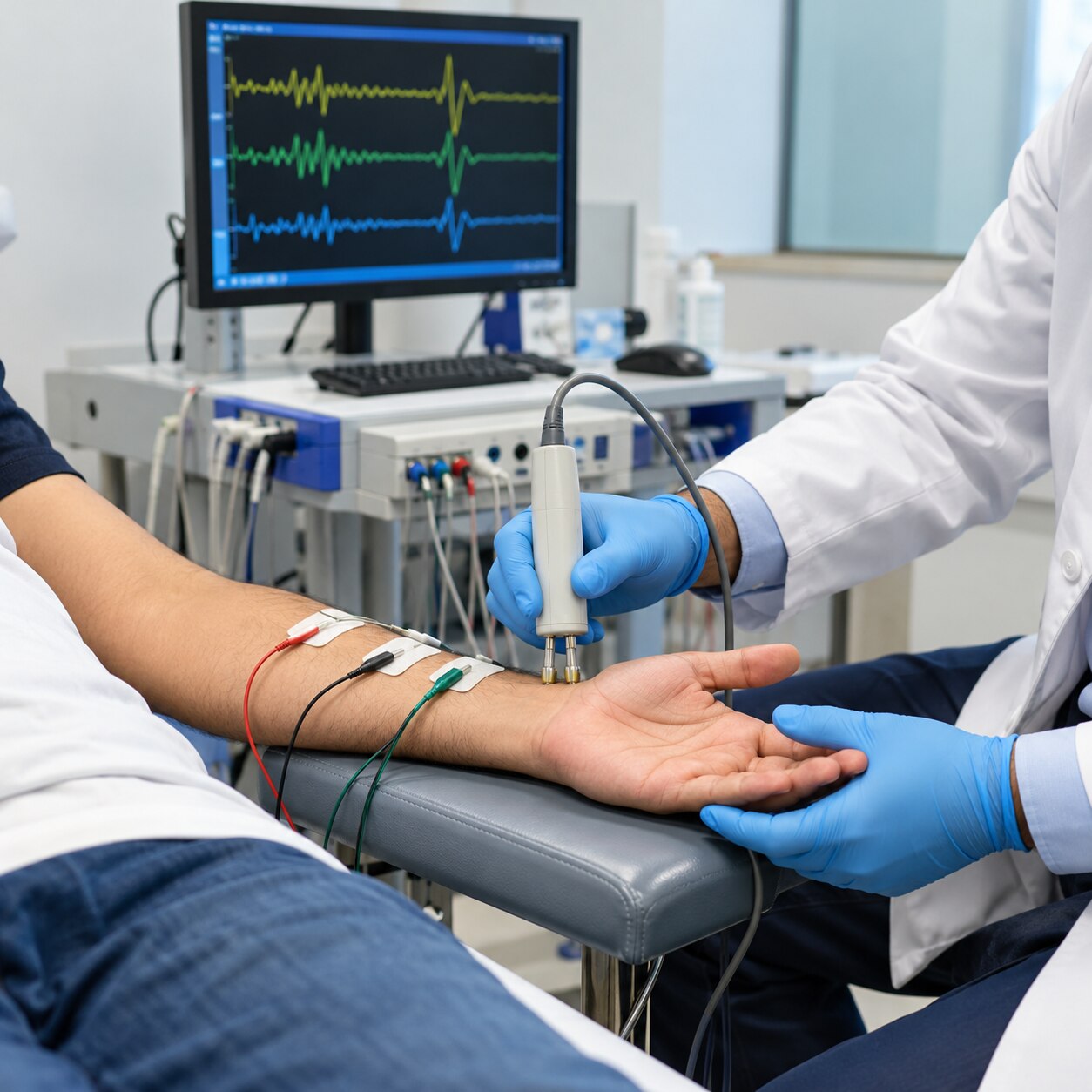
Muscle weakness, numbness, cramps, twitching or fatigability can arise from a muscle, nerve, neuromuscular junction, spinal nerve root or a non-neurological cause. You will learn which clinician to book, which tests may be appropriate, what neuromuscular tests cost in Mumbai, and how to choose a facility without paying for unnecessary investigations.
Key takeaways
- Book a neurologist when weakness affects function, balance or breathing.
- EMG and NCS answer different questions about muscles and nerves.
- Ask facilities what each quoted neuromuscular test cost includes.
- Send symptom timing, medication details and previous reports before booking.
When Symptoms Need Neuromuscular Disorder Diagnosis—and Which Doctor to Book
True muscle weakness means you cannot generate normal force: your leg gives way, you cannot rise from a chair, lift your arms, grip a cup or keep your head upright. Fatigue improves with rest, pain limits movement, tremor causes shaking, and poor coordination makes movement inaccurate without reducing strength.
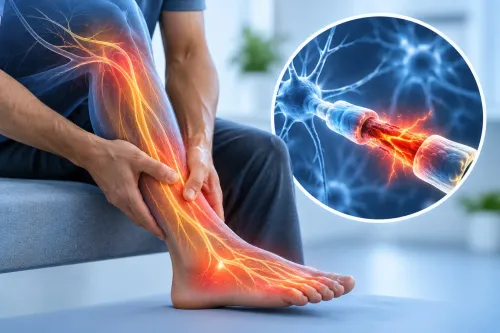
Neuromuscular disorders include peripheral neuropathy, radiculopathy, myopathy, motor neuron disease and neuromuscular-junction disorders. Weakness with numbness, tingling, foot drop, cramps, twitching, muscle wasting, double vision or swallowing difficulty warrants neuromuscular disorder diagnosis. If you searched for neurologist for muscle weakness in Mumbai, book a neurologist first unless the symptoms are an emergency.
| Doctor to book | Best starting point | Clues that fit |
|---|---|---|
| Neurologist | Weakness, altered reflexes, sensory symptoms or unexplained falls | Neuropathy, radiculopathy, myopathy or junction disorders need examination-led testing |
| Orthopaedic doctor | A joint, bone, spine or tendon problem | Injury-related pain, restricted movement or suspected nerve compression |
| Rheumatologist | Possible inflammatory muscle or connective-tissue disease | Symmetric weakness with muscle pain, rash, swollen joints or morning stiffness |
| Endocrinologist | A hormone or metabolic cause is suspected | Thyroid disease, diabetes or electrolyte problems with weakness |
| Emergency department | Rapid, dangerous or sudden symptoms | Breathing or swallowing impairment, stroke-like weakness or severe muscle injury |
Go to emergency care for rapidly progressive weakness, inability to hold your head up, repeated falls, dark urine with severe muscle pain, new difficulty breathing or swallowing, or sudden one-sided weakness.
At booking, state the symptom, duration, age, medicines and prior reports. Say “proximal progressive weakness,” “fatigable ptosis” or “numb feet with weakness,” not “all tests”; the neurologist can then choose a focused sequence.
What the Neuromuscular Work-Up Can Include
A neurologist selects tests according to the weakness pattern, examination findings and suspected site of disease—not by ordering every available investigation. The assessment covers strength, muscle bulk, reflexes, sensation, gait, eye movements, swallowing and breathing, alongside your symptom timeline, medicines and family history.
| Test | What it examines | Why it may be selected |
|---|---|---|
| Blood tests | Creatine kinase (CK), thyroid function, electrolytes and other markers | Raised CK supports muscle injury; thyroid or electrolyte abnormalities can mimic weakness |
| Nerve-conduction studies (NCS) and electromyography (EMG) | Nerve signals and electrical activity within muscle | Helps separate peripheral neuropathy, radiculopathy, motor-neuron disease and myopathy |
| Antibody tests | Immune markers such as acetylcholine-receptor or MuSK antibodies | Investigates neuromuscular-junction disorders, including myasthenia gravis |
| Repetitive nerve stimulation or single-fibre EMG | Signal transmission between nerve and muscle | Useful for fluctuating, fatigable weakness when routine NCS and EMG do not answer the question |
| MRI or other imaging | Brain, spinal cord, nerve roots or affected muscle | Looks for structural causes, inflammation or muscle replacement |
| Genetic testing | Disease-associated gene changes | Considered when the pattern, age of onset or family history suggests an inherited disorder |
| Muscle or nerve biopsy | Tissue structure and immune or protein changes | Reserved for unresolved cases after examination, blood tests, imaging and electrical studies |
The sequence matters. A targeted work-up improves neuromuscular disorder diagnosis and avoids duplicate tests, while biopsy-site selection and the laboratory’s histopathology and immunohistochemistry capability affect its usefulness.
EMG, NCS, Repetitive Stimulation and Single-Fibre EMG Compared
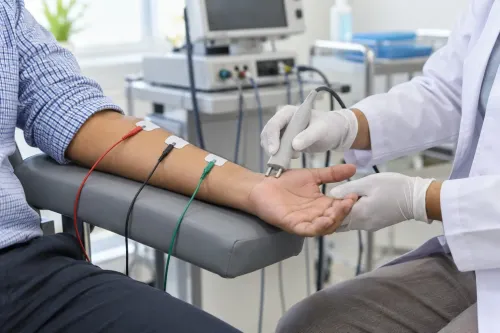
Nerve-conduction studies (NCS) and electromyography (EMG) answer different questions. NCS tests how sensory and motor signals travel along peripheral nerves; needle EMG records electrical activity within selected muscles at rest and during contraction.
| Test | What it measures | Conditions it investigates |
|---|---|---|
| NCS | Signal speed, strength and conduction block in sensory and motor nerves | Carpal tunnel syndrome, polyneuropathy, nerve injury and some radiculopathies |
| Needle EMG | Muscle activity and patterns suggesting denervation, reinnervation or muscle disease | Radiculopathy, motor-neuron disorders and myopathies |
| Repetitive nerve stimulation | Change in muscle response after repeated nerve stimulation, including a decrement or increment | Neuromuscular-junction disorders, especially myasthenia gravis and Lambert-Eaton syndrome |
| Single-fibre EMG | Timing variation, called jitter, between muscle-fibre signals | Subtle neuromuscular-junction transmission defects, including suspected myasthenia gravis |
One test cannot replace another because a normal nerve-conduction result does not exclude a muscle disorder, and needle EMG does not directly measure nerve conduction. Repetitive stimulation challenges signal transmission repeatedly, while single-fibre EMG detects smaller timing abnormalities; routine EMG/NCS may miss these findings.
The neurologist chooses muscles and stimulation methods based on your symptoms and examination. Medication effects, temperature, technical experience and muscle selection influence sensitivity. When searching for neuromuscular testing near me, confirm that the facility has a clinical neurophysiologist who performs the specific study needed for accurate neuromuscular disorder diagnosis.
Neuromuscular Tests Cost in Mumbai and How to Find the Right Facility
Private Mumbai prices vary by test and facility, so treat any advertised neuromuscular tests cost as an estimate. CK or basic muscle-enzyme testing may cost ₹300–₹1,000; EMG/NCS ₹2,000–₹7,000; repetitive nerve stimulation ₹3,000–₹8,000; single-fibre EMG ₹6,000–₹15,000; antibody testing ₹2,500–₹15,000 per assay or panel; and genetic testing ₹10,000–₹60,000 or more.
Before booking, ask these questions:
- Does the fee include the neurologist’s consultation and interpretation?
- Does it cover all four limbs, or only the limbs selected by the doctor?
- Are disposable electrodes, needles, collection charges and a written report included?
- Who reviews the result, and is follow-up with the ordering neurologist included?
- What symptom and referral question should you provide: proximal progressive weakness, fatigable ptosis, or numb feet with weakness?
A search for “neuromuscular testing near me” in Mumbai should lead to a facility that offers the specific test your examination requires, not a package of every test. Search for a neurologist for muscle weakness in Mumbai, then share your symptom timeline, age, medicines and previous reports before testing.
At a clinic such as Dr. Sachin Adukia’s, ask how the examination determines the test sequence and prevents duplicate investigations.
Do not make a routine booking for rapidly worsening weakness, breathing or swallowing difficulty, inability to hold up your head, repeated falls, dark urine with severe muscle pain, or sudden one-sided weakness. Go to emergency care.
Related service
Neuromuscular Disorder Testing Neuromuscular Disorder Testing under the guidance of Dr. Sachin Adukia is a comprehensive diagnostic service designed to accurately identify disorders affecting the nerves,... View service → |
How to Prepare, When to Avoid Routine Booking and What to Send the Neurologist
Send the neurologist a clear timeline, not a request for “all tests.” Include your age, main symptom, date it began, progression, affected muscles, falls, swallowing or breathing changes, family history, previous reports, and every medicine or supplement you take.
- Avoid strenuous exercise for 24 to 48 hours before a creatine kinase (CK) blood test; exercise can raise CK and confuse interpretation.
- Wear loose clothing and avoid applying lotion to the skin before nerve-conduction studies or EMG.
- Ask whether blood thinners, a pacemaker, bleeding disorders, or implanted electrical devices affect the planned test.
- Ask what the quoted neuromuscular tests cost includes: consultation, selected-limb studies, electrodes or needles, written interpretation, and result review.
Genetic testing and muscle biopsy answer different questions.
| Test | What it can establish | When it fits |
|---|---|---|
| Genetic testing | An inherited cause and family risk | Persistent or characteristic disease pattern, specialist recommendation, and access to counselling |
| Muscle biopsy | Tissue-level inflammation, dystrophy, storage disease, or another muscle abnormality | Blood tests, imaging, EMG, antibody testing, and genetics leave a major question unresolved |
Biopsy yield depends on treatment before sampling, site selection, and laboratory immunohistochemistry capability. It is not a routine first step for every weakness complaint.
Do not make a routine booking for rapidly worsening weakness, new breathing or swallowing difficulty, inability to hold your head up, repeated falls, dark urine with severe muscle pain, or sudden one-sided weakness. Seek emergency care; these signs can indicate respiratory failure, rhabdomyolysis, stroke, or another time-critical condition.
Frequently asked questions
When should you see a neurologist for muscle weakness in Mumbai?
Book a neurological assessment when weakness causes falls, difficulty rising, dropping objects, trouble lifting your arms or inability to keep your head upright. Seek urgent care for rapidly worsening weakness, breathing difficulty or trouble swallowing.
What tests can be included in a neuromuscular disorder diagnosis?
The work-up can include a neurological examination, blood tests, nerve conduction studies, electromyography, repetitive nerve stimulation, single-fibre EMG, imaging and genetic or muscle tests when the examination supports them.
What is the difference between EMG, NCS, repetitive stimulation and single-fibre EMG?
NCS measures electrical signals along peripheral nerves. EMG records electrical activity inside muscles. Repetitive stimulation assesses transmission between nerves and muscles, while single-fibre EMG measures very small timing differences between muscle fibres.
What affects neuromuscular tests cost in Mumbai?
Cost depends on the test selected, the number of limbs or muscles examined, whether multiple studies are combined, the facility and the neurologist’s interpretation. Ask for an itemised quote before booking.
How should you prepare for neuromuscular disorder testing?
Wear loose clothing, keep the skin free of creams or oils, bring previous reports and medication details, and tell the facility about pacemakers, blood thinners or implanted electrical devices before the appointment.
Keywords