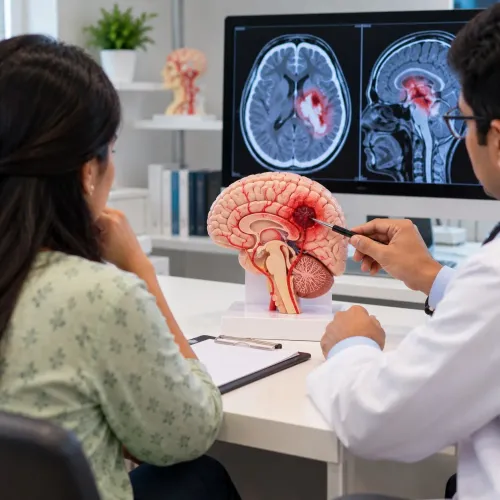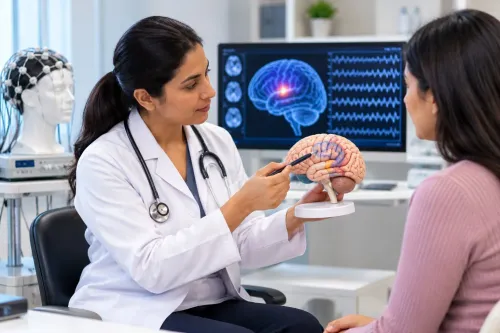
Fever with a severe headache, neck stiffness, confusion, seizure or a sudden change in behaviour needs urgent medical assessment, not a routine appointment. You will learn which symptoms require an emergency department, how doctors distinguish major brain infections, what tests and treatments may follow, and how to arrange safer ongoing care in Mumbai.
Key takeaways
- Seek emergency care for fever with confusion, neck stiffness, severe headache or a new seizure.
- Meningitis affects the coverings; encephalitis affects brain tissue; abscesses form pockets of infection.
- A lumbar puncture is unsafe when raised intracranial pressure or certain bleeding risks are present.
- Do not drive yourself; take medication records and follow every discharge and antibiotic instruction.
Which symptoms mean you need emergency assessment now?
A sudden severe headache with fever, neck stiffness, confusion, unusual drowsiness, or a new seizure needs emergency assessment in Mumbai. Do not wait for a routine neurologist appointment: meningitis and encephalitis can worsen within hours, even when the fever is mild or absent.
If you are asking, “when is brain infection treatment for needed in Mumbai?”, use this decision guide:
| Situation | What to do | Why it matters |
|---|---|---|
| Fever with severe headache, stiff neck, light sensitivity, repeated vomiting, or a non-blanching rash | Go directly to an emergency department | Meningitis can progress to sepsis, brain swelling, or death |
| Confusion, unusual behaviour, memory problems, extreme sleepiness, or reduced consciousness | Seek emergency assessment now | Encephalitis can appear mainly as a change in brain function |
| New seizure, fainting, weakness, trouble speaking, or a rapidly worsening headache | Call emergency services or attend the nearest emergency department | These signs can indicate brain swelling, raised pressure, or another urgent neurological problem |
| Loss of consciousness or abnormal breathing | Call emergency services immediately; do not drive the person | They may need airway support and intensive care |
Do not dismiss neurological changes as stress or dehydration after a viral illness. People with HIV, cancer treatment, transplant medicines, prolonged steroid use, diabetes, or advanced kidney disease need urgent review even with atypical symptoms.
Do not drive after a seizure or loss of consciousness. Take current medicines, medical records, and details of recent infections or immune-suppressing treatment. The emergency team may involve neurology, infectious-disease, intensive-care, or neurosurgical specialists.
How do meningitis, encephalitis, abscess and neurocysticercosis differ?
Meningitis affects the protective membranes around the brain and spinal cord; encephalitis inflames brain tissue; an abscess forms a pus-filled collection; neurocysticercosis results from larval tapeworm cysts in the nervous system. Their symptoms overlap, so symptoms alone cannot identify the cause.
| Condition | Typical clues | Urgency and treatment pathway |
|---|---|---|
| Meningitis | Fever, severe headache, neck stiffness, light sensitivity, vomiting, confusion or a rash | Suspected bacterial disease is an emergency: hospital assessment, lumbar-puncture decisions, and immediate intravenous antibiotics, with other treatment guided by results |
| Encephalitis | Behaviour or memory change, confusion, seizures, reduced consciousness, sometimes fever or headache | Urgent admission for brain imaging, cerebrospinal-fluid testing and often intravenous acyclovir while herpes encephalitis is assessed; seizure control and intensive care may be needed |
| Brain abscess | Worsening headache, fever, vomiting, seizure or a focal problem such as weakness or speech difficulty | Urgent imaging and intravenous antimicrobials; a neurosurgeon may drain a large, accessible or pressure-causing abscess |
| Neurocysticercosis | Seizures, headaches or focal deficits; symptoms depend on cyst number, location and stage | Specialist review and imaging; treatment may include anti-seizure medicine, steroids and selected anti-parasitic therapy, while calcified lesions do not always need antiparasitic drugs |
Brain infection care for adults in Mumbai may require admission even when the person looks stable, because swelling, hydrocephalus, seizures or raised intracranial pressure can develop. Immune suppression also changes the likely organisms and drug choices. Fever can be absent, and a scan or laboratory test—not the symptom pattern—settles the diagnosis.
Which tests might doctors use, and when is a lumbar puncture unsafe?
Doctors identify a brain infection through a combination of blood tests, brain imaging and, when safe, cerebrospinal-fluid analysis. Blood cultures can detect bacteria before antibiotics; other blood tests assess inflammation, organ function and immune status.
A lumbar puncture may be unsafe until clinicians exclude pressure or a mass effect inside the skull. Imaging and specialist review come first when you have:
- A focal neurological deficit, such as one-sided weakness or new speech trouble
- Papilloedema, meaning swelling seen at the back of the eye
- Markedly reduced consciousness
- A new seizure
- A suspected brain abscess, tumour, bleeding or raised intracranial pressure
CT is often the rapid first scan, while MRI can reveal encephalitis, small abscesses or abnormalities that an early CT misses. If bacterial meningitis is strongly suspected, doctors should not postpone intravenous antibiotics while arranging imaging or lumbar-puncture logistics.
| Test | What it can show | Important limitation |
|---|---|---|
| Blood cultures | Bacteria circulating in the blood | A negative result does not exclude infection |
| CT or MRI | Swelling, abscess, bleeding or pressure-related risk | A normal early scan does not rule out encephalitis |
| Lumbar puncture | CSF cells, glucose, protein, Gram stain, culture and PCR | Delay or avoid it when pressure or a mass is suspected |
| EEG | Seizure activity or brain dysfunction | It does not identify every infection |
| Targeted CSF or blood tests | Tuberculosis, fungi, viruses or other organisms | The test must match the suspected cause |
If results remain unclear, clinicians may repeat CSF testing, order MRI, or investigate autoimmune and non-infectious mimics. Disclose HIV, cancer treatment, transplant medicines, prolonged steroid use, diabetes and kidney disease because these conditions change the testing plan.
What treatment and hospital team might be needed in Mumbai?
Treatment depends on what the team suspects and whether the infection has caused swelling, seizures, hydrocephalus, sepsis or reduced consciousness. Doctors often start urgent treatment before every test result returns, then adjust it when spinal-fluid, blood, imaging or microbiology findings identify the cause.
- Bacterial meningitis: intravenous antibiotics, with corticosteroid treatment in selected cases.
- Viral encephalitis, especially suspected herpes simplex: prompt intravenous antiviral treatment.
- Tuberculosis or fungal infection: prolonged, organism-specific medicines, with dosing reviewed for kidney or liver disease.
- Brain abscess: intravenous antibiotics and neurosurgical assessment; drainage may be needed if pus, pressure or deterioration threatens the brain.
- Neurocysticercosis: antiparasitic treatment is not automatic; imaging helps decide whether it is appropriate, and corticosteroids may be needed to control inflammation.
A hospital admission remains sensible even when you look stable because seizures, brain swelling, breathing failure and raised intracranial pressure can develop quickly. The team may include an emergency physician, neurologist, infectious-disease physician, microbiologist, intensivist and neurosurgeon, with EEG, repeated neurological examinations or rehabilitation added when needed.
Seek emergency assessment now for confusion, unusual sleepiness, a seizure, new weakness, speech difficulty, severe headache with fever or neck stiffness, repeated vomiting, loss of consciousness or breathing problems. Do not wait for a brain infection doctor in Mumbai or a routine appointment.
A neurologist for brain infection in Mumbai, such as Dr. Sachin Adukia, may coordinate ongoing care after emergency stabilisation, especially when immune suppression changes drug choices or admission needs.
Related services
Brain Infection Treatment Dr. Sachin Adukia is a highly experienced neurologist offering advanced and comprehensive Brain Infection Treatment with a patient-centric approach. View service → |
Encephalitis Treatment Dr. Sachin Adukia, a highly experienced Neurologist, provides expert diagnosis and comprehensive treatment for Encephalitis, a serious neurological... View service → |
What should adults do while arranging care and after discharge?
Before treatment, record when symptoms began and how they changed. Give the team your current medicines, allergies, recent infections, travel, animal or mosquito exposure, tuberculosis contact, vaccination history and any previous seizures. Do not drive after a seizure or loss of consciousness; call emergency services if breathing or consciousness is affected.
- Bring medicine strips, prescriptions, discharge papers, scan reports and laboratory results.
- Tell clinicians about HIV, cancer treatment, transplant medicines, prolonged steroid use, diabetes or advanced kidney disease.
- Report pregnancy, recent neurosurgery, immune-suppressing drugs and missed medicines.
- Ask whether you need admission, repeated neurological checks, an EEG or intensive monitoring; a stable appearance does not exclude later seizures, brain swelling, hydrocephalus, sepsis or respiratory failure.
| Risk factor | Why it changes care | What to disclose |
|---|---|---|
| Weakened immunity | Broadens possible infections and can blunt fever | Diagnosis, treatment and drug doses |
| Kidney disease | Some antimicrobials need dose adjustment | Latest kidney results and medicines |
| Prolonged steroids | Raises risk of unusual or fungal infections | Dose and duration |
| Recent neurosurgery or head injury | Raises concern for specific organisms or an abscess | Procedure date and hospital |
Brain infection care for adults in Mumbai does not end when tests clear the infection. Arrange follow-up for hearing loss, seizures, memory, concentration, balance, weakness, mood, behaviour, swallowing or work limitations. Audiology, rehabilitation, neuropsychology and seizure clinics may be needed; seek urgent review for a new seizure, worsening confusion, weakness or severe headache.
Frequently asked questions
When should someone with possible brain infection seek emergency assessment in Mumbai?
Seek emergency assessment immediately for severe headache with fever, neck stiffness, confusion, unusual drowsiness or a new seizure. Do not wait for a routine neurologist appointment.
How do meningitis, encephalitis, brain abscess and neurocysticercosis differ?
Meningitis is infection of the membranes around the brain and spinal cord. Encephalitis affects brain tissue. A brain abscess is a localised pocket of infection, while neurocysticercosis results from larval Taenia solium cysts in the nervous system.
When is a lumbar puncture unsafe for suspected brain infection?
Doctors may defer lumbar puncture when examination or brain imaging suggests raised intracranial pressure, a mass or abscess, obstructed cerebrospinal-fluid pathways, or a serious bleeding risk.
What treatment and hospital team may be needed for brain infection care in adults in Mumbai?
Care can involve emergency physicians, neurologists, infectious-disease specialists, intensivists, microbiology staff and neurosurgeons. Treatment depends on the cause and may include intravenous antimicrobials, antiviral medicine, anti-seizure treatment, steroids in selected situations, drainage or antiparasitic therapy.
Keywords