Muscle weakness that becomes more noticeable after repeated activity can raise a different set of neurological questions from weakness that remains constant throughout the day. When the clinical pattern suggests a disorder affecting communication between nerves and muscles, a neurologist may recommend an RNS test, or repetitive nerve stimulation.
For patients in Powai, Mumbai, this test is most useful when selected for a specific neuromuscular question rather than being used as a general investigation for tiredness.
What Is the Neuromuscular Junction?
A nerve does not physically continue into a muscle fibre. Instead, nerve and muscle communicate across a specialized connection known as the neuromuscular junction.
When an electrical signal reaches the end of a motor nerve, chemical processes allow the muscle to respond and contract.
Certain neurological disorders interfere with this transmission. Myasthenia gravis is a well-known example, although neuromuscular junction disorders include other conditions as well.
How Repetitive Nerve Stimulation Works
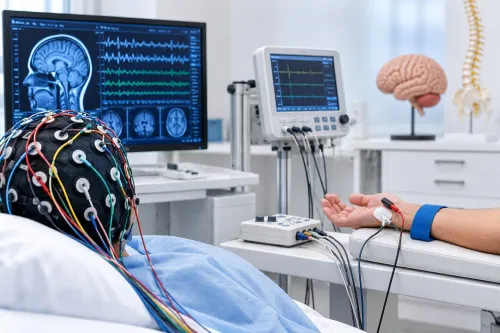
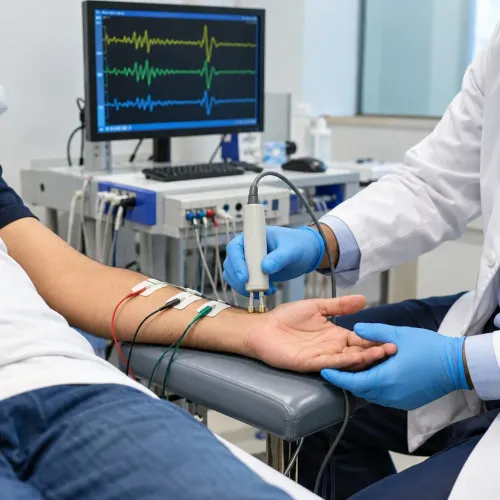
During RNS, electrodes are positioned to record a muscle response while the corresponding nerve is stimulated repeatedly.
Instead of looking only at one response, clinicians examine what happens to the muscle response across a sequence of stimuli.
A characteristic change under specific testing conditions may provide evidence of abnormal neuromuscular transmission.
Different nerves and muscles can be selected according to the patient's symptoms.
What Symptoms May Lead to RNS Testing?
The test may be considered when a person experiences patterns such as:
- Weakness that fluctuates
- Drooping eyelids
- Double vision associated with weakness
- Difficulty chewing after prolonged activity
- Changes in speech with continued talking
- Swallowing difficulty
- Neck weakness
- Limb weakness that worsens with repeated use
These symptoms do not automatically mean a patient has myasthenia gravis. Several neurological and non-neurological conditions can produce fatigue or weakness.
The neurological examination helps determine whether the pattern resembles fatigable muscle weakness.
RNS Is Only One Part of the Evaluation
An RNS result is interpreted alongside the clinical picture.
Depending on the suspected condition, additional investigations can include antibody testing, routine nerve conduction studies, EMG, specialized electrophysiological testing, and imaging.
For suspected myasthenia gravis, blood tests may look for relevant antibodies. Imaging of the chest may also be considered in confirmed or strongly suspected cases to evaluate the thymus.
Not every patient will require every investigation.
Why Choosing the Right Muscles Matters
Neuromuscular junction disorders may affect certain muscle groups more prominently than others. Testing a clinically unaffected muscle may be less informative than selecting muscles based on the patient's symptom pattern.
This is one reason specialist evaluation before electrodiagnostic testing is valuable.
The timing of testing, medications, temperature, and technical factors may also influence results and therefore require appropriate interpretation.
When Weakness Becomes Urgent
Difficulty swallowing, choking, rapidly worsening generalized weakness, or breathing difficulty requires prompt medical attention. These symptoms can indicate significant involvement of muscles responsible for essential functions.
Patients should not wait for a scheduled outpatient nerve test if breathing or swallowing is deteriorating.
For people in Powai and nearby Mumbai communities, Dr. Sachin Adukia evaluates patterns of unexplained weakness and can determine whether repetitive nerve stimulation or another neuromuscular investigation is appropriate.
An RNS test has a focused purpose: evaluating how reliably nerves communicate with muscles during repeated stimulation. When the patient's symptoms, examination, and test findings are considered together, it can contribute valuable evidence in the assessment of suspected neuromuscular junction disorders.
Keywords